Rural domestic sewage treatment is an important measure to improve rural living environment and implement rural revitalization strategies. In recent years, the state and local governments have continued to increase investment in rural sewage treatment, and integrated sewage treatment equipment has become one of the mainstream solutions for decentralized village management.
Compared with urban sewage treatment, rural domestic sewage has the characteristics of large fluctuations in water volume, scattered population, obvious changes in influent concentration, and insufficient professional operation and maintenance personnel. Therefore, rural domestic sewage treatment equipment does not mean that the treatment capacity is larger, the better, nor does it mean that the process is more complex and advanced.
Based on real county projects, this paper systematically explains the logic of rural sewage equipment selection from the perspectives of treatment mode, design scale, process route, price range, operation and maintenance costs, and manufacturer screening.
Project background: A typical county rural sewage project explains why the selection cannot be used in one set of templates”
Take a rural domestic sewage treatment project in Dayi County, Sichuan Province as an example. The project has been approved and implemented by the County Development and Reform Bureau. The construction contents mainly include:
Four new integrated sewage treatment facilities have been builtwith a total treatment capacity of 190 tons/day;
Expand 37 integrated sewage treatment facilitieswith a total treatment capacity of 2750 tons/day;
Equipment maintenance and technical transformation of 46 existing rural domestic sewage treatment facilities, with a total treatment capacity of 4465 tons/day;
A newly built supporting sewage collection pipe network is about 5000 meters.
The project covers Qingxia Street, Jinyuan Street, Shaqu Street, Anren Town, Wangsi Town, Xinchang Town, Huashuiwan Town, Yuelai Town, Chujiang Town, Heming Town, Xiling Town and other towns and streets. It is a typical multi-point decentralized, miniaturized, new construction + expansion + technological transformation coexistence rural sewage treatment project.
This case illustrates a key question:
Rural sewage treatment facilities are often not a large sewage plant, but a combination of dozens of small stations. Different villages have different populations, different water volumes, different water outlet requirements, and different original facilities and conditions. Naturally, equipment selection cannot be used in one set of templates.
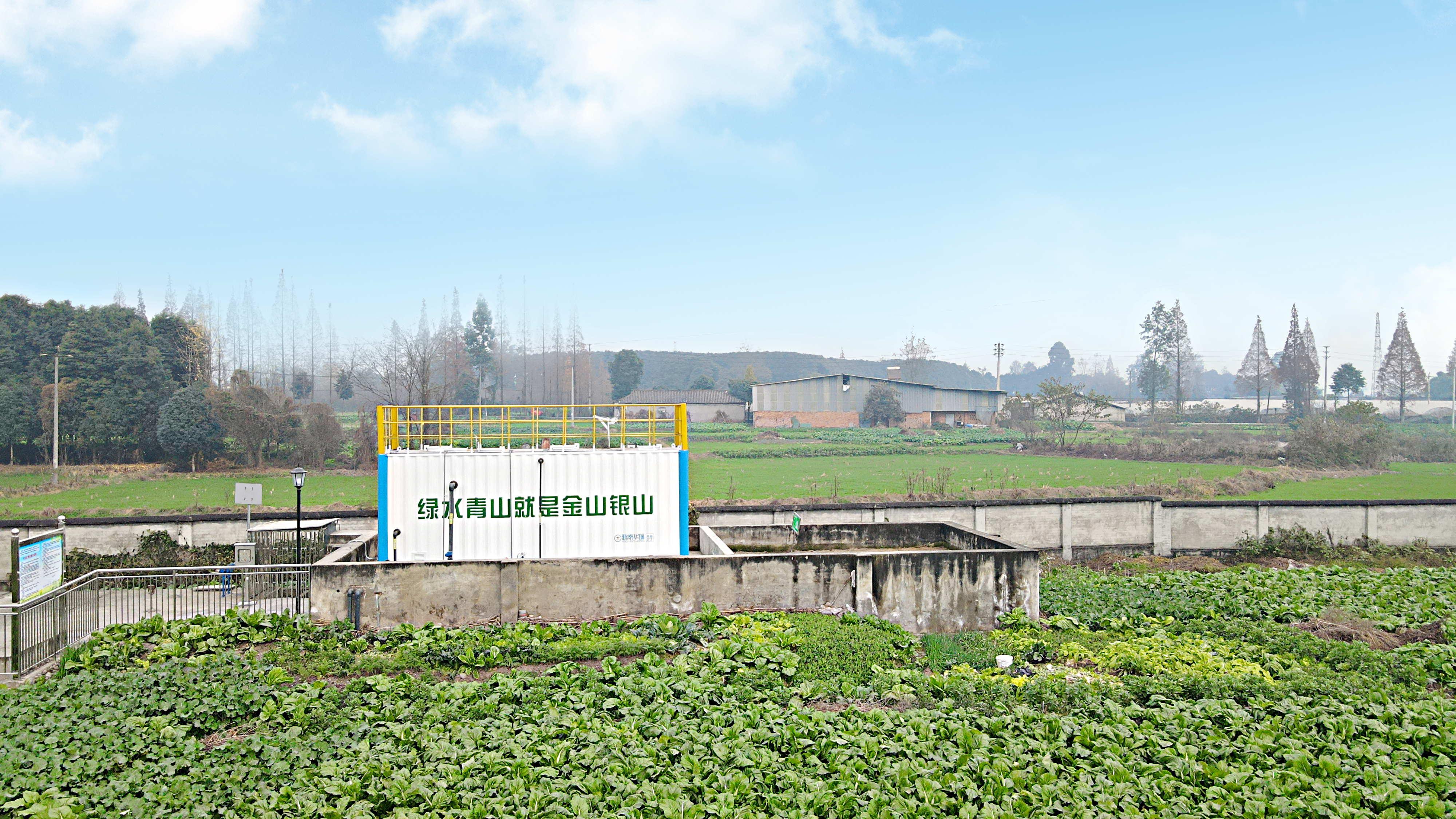
1. Select rural sewage treatment equipment, first determine: centralized treatment or decentralized treatment?
Before selecting equipment, you first need to determine whether the project is suitable for management, centralized processing or decentralized processing.
If the village is close to the urban sewage pipe network and has the conditions for takeover, it can usually be given priority to inclusion in the urban sewage treatment system.
If the population of the village is relatively concentrated, sewage can be collected centrally through the pipe network, and village-level or district sewage treatment stations can be built.
For villages with scattered residences, long distances, complex terrain, and high cost of laying large-scale sewage pipe networks, it is more suitable to use decentralized sewage treatment or small integrated sewage treatment equipment.
Therefore, determining the processing mode before equipment selection is more important than directly asking“ which equipment manufacturer is” better.
2. The scale of the equipment is not as big as possible, so be wary of false design heights and stepping on pits.
Treatment scale is a basic parameter in the selection of rural sewage treatment equipment.
Many projects are prone to a problem during the design: the equipment is designed to be large, but the actual amount of sewage entering the equipment is far lower than the design value.
The rural population may go out to work and live seasonally, and the actual sewage volume may be lower than the theoretical design value for a long time. At the same time, rural domestic sewage also has obvious day and night changes.
Therefore, when determining the scale of equipment, we cannot simply calculate based on the per capita displacement of the permanent population. We also need to consider comprehensively:
- number of permanent residents
- per capita water consumption
- sewage collection rate
- Actual average daily sewage volume
- Maximum daily sewage volume
- Diurnal water volume changes
- Rain and sewage diversion
- Future demographic changes
For example, for a village with the same 500 people, if one village has a stable permanent population and the other village has a large number of people who go out to work, the actual sewage volume and operating conditions of the two projects may be completely different.
Many rural projects calculate the design water volume directly based on the registered population. A large number of villagers go out to work. The equipment is operating at low load for a long time, and the biochemical system is prone to failure. This is a high-frequency spot for rural sewage projects.
Therefore, the scale of equipment should match the actual sewage volume, rather than simply pursuing“ large treatment capabilities”.
3. What are the common processes of rural domestic sewage treatment equipment?
At present, there are many processes that can be used in rural domestic sewage treatment projects, including A/O, A²/O, biological contact oxidation, MBBR, MBR, constructed wetlands, etc. Local discharge standards for rural sewage are implemented differently in different regions, and local effluent indicators must be confirmed before type selection.
|
process route
|
effluent quality
|
equipment investment
|
operation energy consumption
|
maintenance difficulty
|
applicable scenarios
|
|
A/O
|
in
|
lower
|
lower
|
lower
|
Small village-level treatment, average effluent requirements
|
|
A²/O
|
middle and high
|
medium
|
medium
|
medium
|
Village-level centralized treatment requiring nitrogen and phosphorus removal
|
|
MBBR
|
middle and high
|
middle and high
|
medium
|
middle and low
|
Villages with large fluctuations in water quality
|
|
MBR
|
high
|
high
|
high
|
high
|
Projects with high water outlet requirements and tight available land
|
|
constructed wetland
|
in
|
lower
|
extremely low
|
low
|
Small villages with good land conditions
|
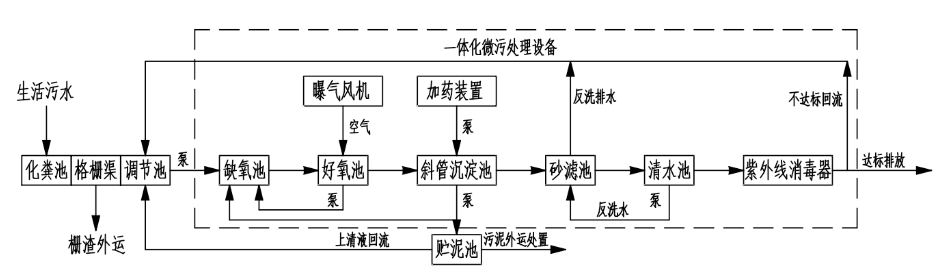
When selecting a process, you should not simply compare“ which process is best”, but should comprehensively evaluate:
Intake water quality + treatment scale + effluent requirements + land conditions + investment budget + operation and maintenance capabilities.
4. Why does rural sewage equipment pay special attention to its ability to resist fluctuations in water quantity and water quality?
This is one of the obvious differences between rural sewage treatment and urban sewage treatment.
Rural domestic sewage often does not enter the treatment system in a stable, continuous and large flow.
Water consumption is large during the day, but may decrease significantly at night; during holidays, busy farming seasons and when people return home, water intake may suddenly increase.
If the equipment is in low-load operation for a long time and then encounters a large amount of water entering for a short period of time, it may have an impact on the biochemical system.
Therefore, when selecting rural domestic sewage treatment equipment, in addition to looking at the design treatment capacity, we should also pay attention to:
The adaptability of equipment to water volume fluctuations, water quality changes and long-term low-load operation.
This is also why rural projects cannot simply copy the design ideas of urban sewage plants.
5. How much is the price of rural sewage treatment equipment? The market reference range is here
There are many users searching for how much rural sewage treatment equipment costs, but it is difficult to answer with a unified price for rural sewage equipment. Because the price is directly related to factors such as treatment scale, process route, equipment material, degree of automation, water outlet standards, and installation conditions.
The following gives the common price range of integrated sewage treatment equipment in the market for reference in early estimates.
1. Equipment investment reference price
The following prices are forintegrated sewage treatment equipment,
Excluding civil engineering, pipe network, installation and electrical supporting facilities.
|
treatment scale
|
Equipment investment reference price
|
Ton water investment reference
|
|
10 tons/day
|
60,150,000 yuan
|
6,000 RMB 15,000/ton
|
|
30 tons/day
|
120,250,000 yuan
|
0.4 million 0.8 million yuan/ton
|
|
50 tons/day
|
180,350,000 yuan
|
0.36 million 0.70 million yuan/ton
|
|
100 tons/day
|
300,000 600,000 yuan
|
0.3 million 0.6 million yuan/ton
|
|
200 tons/day
|
551 million yuan
|
0.28 million 0.5 million yuan/ton
|
2. Impact of process on price
- A/O, A²/O processes: The equipment price is relatively moderate and suitable for most rural projects;
- MBBR process: equipment investment is medium to above, and its ability to withstand impact load is strong;
- MBR process: Equipment investment is usually 30% 50% higher than conventional processes, but effluent quality is more stable;
- Artificial wetland: Civil engineering covers a large area and low equipment investment, but it is limited by land conditions.
3. Operating cost reference
The operating costs of rural sewage treatment equipment mainly include electricity, pharmaceutical fees, maintenance fees and manual inspection fees.
|
cost item
|
Market reference range
|
|
electricity
|
0.3 0.7 yuan/ton of water
|
|
chemical cost
|
0.05 0.2 yuan/ton of water
|
|
Daily maintenance of small village-level facilities
|
0.5 15,000 yuan/year seat
|
|
Comprehensive operating cost per ton of water
|
0.8 2.0 yuan/ton
|
Due to the needs of membrane scrubbing, aeration and membrane cleaning, the electricity bill of the MBR process is usually 0.2 0.4 yuan/ton of water higher than that of the conventional process. The membrane modules generally need to be replaced every 35 years. This part of the cost must also be included in the full life cycle cost.
The above prices are for reference only. The actual price needs to be comprehensively determined based on inlet water quality, outlet water standards, equipment materials, automation configuration and project location.
6. How to screen rural sewage treatment equipment manufacturers? Don't be superstitious about factory rankings
If you enter the actual procurement stage, instead of simply searching the rankings of rural sewage treatment equipment manufacturers, it is better to judge from the following aspects.
1. Look at similar project cases
The focus is on whether the manufacturer has actually carried out rural domestic sewage projects.
Don't just look at the number of cases, but also look at: treatment scale, inlet water quality, outlet water requirements, local climate, operating time and actual operating conditions.
2. See if the equipment matches the process
The same equipment may not be suitable for all rural projects.
Manufacturers should be able to select models based on the actual water volume, water quality and emission requirements of the project, rather than directly applying standard equipment.
3. Look at post-operation and maintenance capabilities
One of the biggest practical problems in rural projects is the shortage of professionals.
Therefore, we can focus on understanding whether the manufacturer can provide: remote monitoring, operating data management, fault alarm, equipment maintenance and technical support.
4. Look at long-term operating costs
Don't just compare equipment quotes.
When purchasing, it is best to have the manufacturer provide: design parameters, main equipment configuration, estimated energy consumption, maintenance cycle, consumables, and operation and maintenance expenses.
Only by putting these data together can we truly judge whether the device is cost-effective.
7. A complete set of rural sewage equipment selection logic
If you summarize the previous content, you can form a clear selection judgment order:
Village conditions Sewage quantity Intakes water quality Outcomes requirements Process selection Equipment scale Operation and maintenance method Full life cycle cost
Instead of: the manufacturer quotes the equipment model and purchases it directly.
For rural domestic sewage projects, the really good equipment is not necessarily the most complex equipment, but should be:
Equipment that matches the characteristics of local sewage, can operate stably for a long time, is simple in operation and maintenance, and has reasonable overall cost.
8. FAQ on common problems on rural sewage treatment equipment
Q1: How much does a set of rural domestic sewage treatment equipment cost?
以10— 50吨/日一体化设备为例,设备价格大约在6万—35万元之间。If the MBR process is used, the price will increase by 30% to 50%, and additional civil engineering, pipeline and installation costs will be required.
Q2: Which process is the best for rural sewage treatment equipment?
没有绝对最好的工艺。Generally, A²/O can be selected for stable population and effluent requirements; MBBR can be selected for large fluctuations in water volume; MBR can be selected for high effluent requirements; artificial wetlands can be selected for good land conditions and small scale.
Q3: How long can the integrated sewage treatment equipment last?
常规碳钢防腐设备设计寿命一般在10— 15年,玻璃钢或不锈钢材质可达15— 20年。Membrane modules are vulnerable parts and usually need to be replaced in 35 years.
Q4: Do rural sewage treatment stations need special personnel to be on duty?
一体化设备自动化程度较高,通常不需要24小时专人值守,但应配置远程监控和定期巡检。Professional operation and maintenance generally recommends inspections once a week or month.
Q5: What standards can rural sewage equipment effluent meet?
多数一体化设备可满足农村生活污水处理设施排放标准中的一级B或一级A要求,具体取决于工艺配置、设备参数和当地排放标准。
conclusion
The choice of rural domestic sewage treatment equipment is essentially not simply choosing a machine, but choosing a sewage treatment plan that can operate for a long time.
Especially for rural projects with scattered populations, significant fluctuations in sewage volume, and insufficient professional operation and maintenance personnel, the stability, impact resistance, automation and post-operation and maintenance capabilities of equipment are often more important than simply comparing equipment prices.
If a rural domestic sewage treatment project is being built, it is recommended to clarify at least five data items before purchasing equipment:
Treatment scale, influent water quality, effluent standards, on-site construction conditions, and post-operation and maintenance methods.
Only after these conditions are clear can we truly judge what kind of rural domestic sewage treatment equipment is suitable for our project.
Need advice on rural sewage equipment selection?
If you have a village sewage treatment project at hand, you can follow the following steps to obtain a preliminary selection evaluation for free:
Organize basic information of the project: permanent population, design water volume, effluent standards, site conditions, and whether there are existing facilities;
Prepare on-site photos or floor plans;
Submit it to a technical consultant for preliminary process recommendations and investment budget ranges.
【咨询设备报价:19102876179 】





 hthrjt2017@gmail.com